


Materiality Assessment


JAS Asset Public Company Limited ("J") conducts its sustainability materiality assessment based on the principle of Impact Materiality
In order to identify and evaluate actual and potential impacts arising from the company's business operations on the economy, society, environment, and relevant stakeholders. The focus is place on the impacts of organizational activities throughout the value chain — from project development, rental space management, and services provided to tenants and users, through to resource and environmental management within its projects.
This Sustainability Report has been prepared in accordance with the reporting standards of the Global Reporting Initiative (GRI Standards 2021) and the Sustainable Development Goals (SDGs) to ensure transparent, comprehensive, and internationally aligned disclosure. The Company places importance on assessing and reflecting the impacts of its business operations in a comprehensive manner in order to clearly and appropriately disclose material sustainability issues. The process for determining the report content is detail as follows.

Understanding the Organizational Context

Identification of Actual and Potential Impacts

Impact Assessment

Prioritization and Determination of Material Topics
Understanding the Organizational Context
The Company analyzes both internal and external organizational contexts related to its business operations in developing and managing shopping centers and commercial spaces. Internal factors considered include corporate governance structure, risk management and internal control systems, lease contract management, building management and safety, energy, water, and waste management systems, as well as the use of technology and information systems in operations. External factors considered include economic conditions and consumer purchasing power, retail industry and commercial real estate trends, laws and regulations relating to urban planning, building safety, the environment, and consumer protection, community expectations surrounding its projects, and risks from climate change. This analysis covers the entire value chain — from site selection, design and construction, rental space management, and promotional activities, through to building management — in order to understand the conditions that may give rise to impacts on stakeholders from the Company's business operations.

Identification of Actual and Potential Impacts
The Company identifies both negative and positive impacts, whether actual or potential, arising from its activities and business relationships, considering impacts on tenants, service users, communities, employees, business partners, and the environment. Impact identification is carried out through collecting feedback and complaints from tenants, service users, and communities, analyzing past incidents, reviewing relevant legal requirements and standards, and conducting internal discussions with relevant departments — while determining whether such impacts are directly caused by the Company's operations, contributed to by the Company, or linked through business relationships.

Impact Assessment
The Company assesses the significance of impacts using defined criteria, namely: likelihood of occurrence, severity of impact, scope of impact, and remediability. In assessing negative impacts, the Company places primary emphasis on the severity of the impact, particularly on matters relating to human rights and fairness. For positive impacts, consideration is given to the number of beneficiaries, the continuity of outcomes, and the extent to which the quality of life or economic security of those involved is improved.

Prioritization and Determination of Material Topics
The Company prioritizes assessment results, whereby topics with high impact levels or broad stakeholder scope are designated as material sustainability topics. These topics are then used to define management approaches, performance indicators, and disclosures in the sustainability report, and are reported to the Board of Directors for ongoing oversight.

Prioritization of Material Sustainability Issues
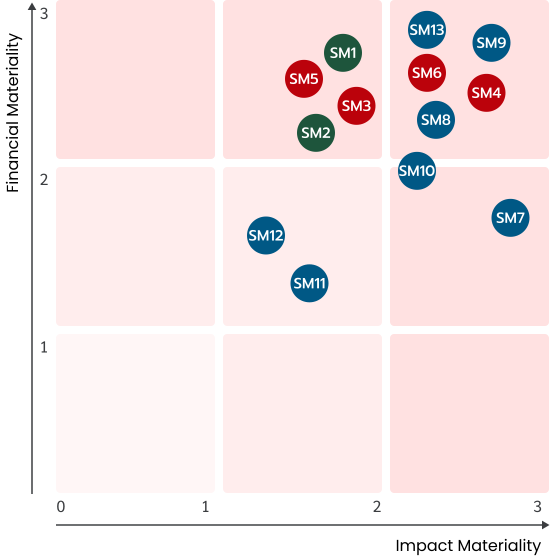
In 2025, the executives of JAS Asset Public Company Limited conducted a materiality prioritization process by considering key issues that impact the Company in terms of environment, society, corporate governance, and economy.
There are a total of 13 issues. For the material issues that impact stakeholders in all groups, the Company has prioritized them based on the consideration of the impact on the Company’s operations as follows:
-
SM1Resource and Environmental Management
-
SM2Climate Change
-
SM3Human Rights
-
SM4Employee Care and Development
-
SM5Community Engagement
-
SM6Occupational Health and Safety
-
SM7Sustainable Returns
-
SM8Innovation and Technology
-
SM9Sustainable Supply Chain Management
-
SM10Data Protection and Information Systems
-
SM11Anti-Corruption
-
SM12Corporate Governance, Risk Management, and Legal Compliance
-
SM13Product Quality, Safety, and Customer Satisfaction
Review of Issues
The Company reviews its material issues annually to ensure alignment with the evolving business context, corporate strategy, relevant laws and regulations, and the expectations of stakeholders. The review considers impacts across economic, social, and environmental dimensions, as well as risks and opportunities that may affect the financial position and operating performance of the Group.The results of the review are presented to the Board of Directors for consideration and approval prior to disclosure in the annual Sustainability Report. In addition, the Company reports progress on sustainability performance to the Board at least twice a year to support continuous oversight and monitoring, and prepares an overall performance report annually to disclose information to stakeholders in a transparent and verifiable manner.