


Corporate Governance


Our Commitment
JAS Asset Public Company Limited is committed to conducting its business in accordance with the principles of good corporate governance, emphasizing transparency, accountability, and fairness to build trust among shareholders, investors, business partners, customers, employees, and all stakeholders. The company recognizes that these principles are the foundation of credibility and long-term organizational sustainability.
The company firmly believes that good corporate governance is a crucial foundation for sustainable growth. Therefore, JAS Asset adheres to ethical business practices, compliance with laws, regulations, and relevant policies, and promotes a corporate culture that values responsibility, integrity, and transparency in every operational process.
Furthermore, the company is committed to developing an effective governance structure, in which the Board of Directors plays a key role in setting the company’s direction, strategies, and oversight to ensure that operations are properly managed and aligned with economic, social, and environmental goals. This approach enables the company to achieve sustainable growth while creating long-term shared value for society.
Supporting the SDGs Goals





Stakeholders Directly Impacted


Goals and Performance Highlights
Goals

- The annual target for Business Ethics violations must be zero, covering any breaches of the Code of Business Ethics by the Board of Directors, Management, and employees at every level.
- Assessment result from the Corporate Governance Report of Thai Listed Companies (CGR) at the “Very Good” level (4 stars).
Performance

For 2025, the target for Business Ethics violations is

In 2025, the Company received 100 points from the Annual General Meeting (AGM) Checklist, the quality assessment program for shareholders’ meetings of listed companies, at the

In 2025, the company received the assessment result of the Corporate Governance Report of Thai Listed Companies (CGR) with

In 2025, the Company received a SET ESG Rating of


Management Approach and Value Creation
To genuinely strive to be a company with good governance, the Company has established the Code of Best Practice for Listed Companies. This framework promotes business operations based on good corporate governance principles.
The Company has developed clear policies on corporate governance, emphasizing transparency at every level of operation, from operating staff and management to the Board of Directors. This is intended to build confidence that all parties within the organization adhere to high ethical and fair standards equally, which forms a crucial foundation for the sustainable development of operational efficiency.
Furthermore, this policy focuses on improving efficiency and increasing the effectiveness of business operations, enabling the Company to create long-term value for shareholders, as well as all relevant stakeholders.
Consequently, the Company adheres to and strictly follows the principles of good corporate governance in accordance with the guidelines set by the Stock Exchange of Thailand (SET), which consists of 15 key best practices. These cover every dimension of governance, including ethics, transparency, social responsibility, and fairness in business operations, as detailed below

Good Corporate Governance Policy

Rights and Equality of Shareholders

Rights of Different Stakeholder Groups

Shareholders' Meeting

Leadership and Vision

Conflict of Interest

Business Ethics

Board Balance and Board Diversity

Consolidation or Separation of Positions

Remuneration of the Board of Directors and Executives

Board Meeting

Audit Committee

Internal Control and Audit System

Board of Directors' Report

Investor Relations
Corporate Governance Structure
In the context of a complex, volatile, and ever-changing business environment, JAS Asset Public Company Limited has designed its corporate governance structure to promote operations in accordance with good corporate governance principles.
Decision-making is based on effective and sufficient information, while ensuring that directors and executives at all levels perform their duties responsibly, carefully, and with integrity, in compliance with the law, regulations, shareholders' resolutions, and the policies or guidelines established. This approach is aimed at achieving the highest benefits for the organization, shareholders, and all relevant stakeholders.
Corporate Governance Structure of JAS Asset Public Company Limited as of December 31, 2025
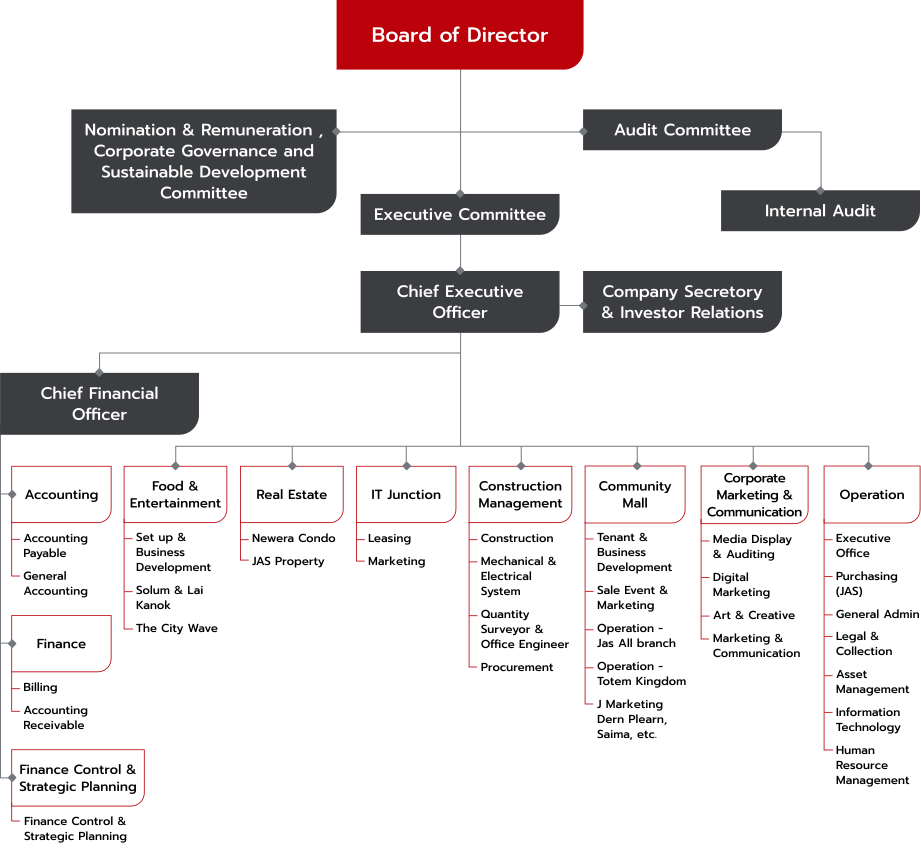
The company has a board of directors responsible for setting the company’s policies and strategies. The board members meet the qualifications specified under Section 68 of the Public Limited Companies Act and the regulations set by the Securities and Exchange Commission regarding the permission and approval for the issuance of new shares. Furthermore, the board members do not fall under the prohibited criteria set forth in Section 4/2 of the Asset Management Company Act. The board plays a leadership role in protecting the interests of shareholders and stakeholders by defining policies, objectives, strategies, and directions for business operations, both in the present and long-term. The board also establishes audit processes and governance to ensure the company’s business operations comply with laws, the company’s objectives, articles of association, and shareholders' resolutions, while maintaining transparency to create value for the organization’s sustainability.
The board has established three sub-committees: The Audit Committee, the Nomination and Remuneration Committee and Sustainability Governance Committee. and the Executive Committee. Additionally, to ensure business operations align with policies, objectives, strategic plans, and the company’s vision, the company has set business goals as a framework for its operations.
The Executive Committee
The board of directors, as the leader or the highest responsible body of the company, has the duty and responsibility to oversee the business operations to ensure that the company operates in accordance with its objectives and goals. This includes safeguarding the interests of shareholders and complying with laws and regulations set by regulatory authorities. Therefore, the board must perform its duties with caution, care, integrity, and transparency, always considering the best interests of the company in order to create added value for the business and shareholders.
The Nomination and Remuneration Committee and Sustainability Governance Committee
Appointed by the Board of Directors within the scope of overseeing and governing corporate sustainability, to promote, support, and elevate the standards of good corporate governance practices. The goal is to develop the business with sustainability in mind, considering stakeholders throughout the value chain, and driving the Jaymart Group to comprehensively address business risks. This includes focusing on environmental, social, and governance (ESG) dimensions, while promoting transparency in the disclosure of corporate governance information and sustainable business development, reflecting the true value and worth of the JAS Asset’s.
The Audit Committee
To enhance the effectiveness of the Board of Directors’ duties and ensure that the Company complies with all applicable laws, regulations, and internal policies, as well as maintains accurate and reliable financial reporting, efficient and effective operations, and adequate internal controls, the Board of Directors has appointed the Audit Committee. The Audit Committee operates independently from management and is responsible for reviewing the adequacy and appropriateness of the Company’s internal control systems, as well as performing other duties as assigned by the Board of Directors, to ensure that the Company’s operations are conducted in alignment with its objectives.